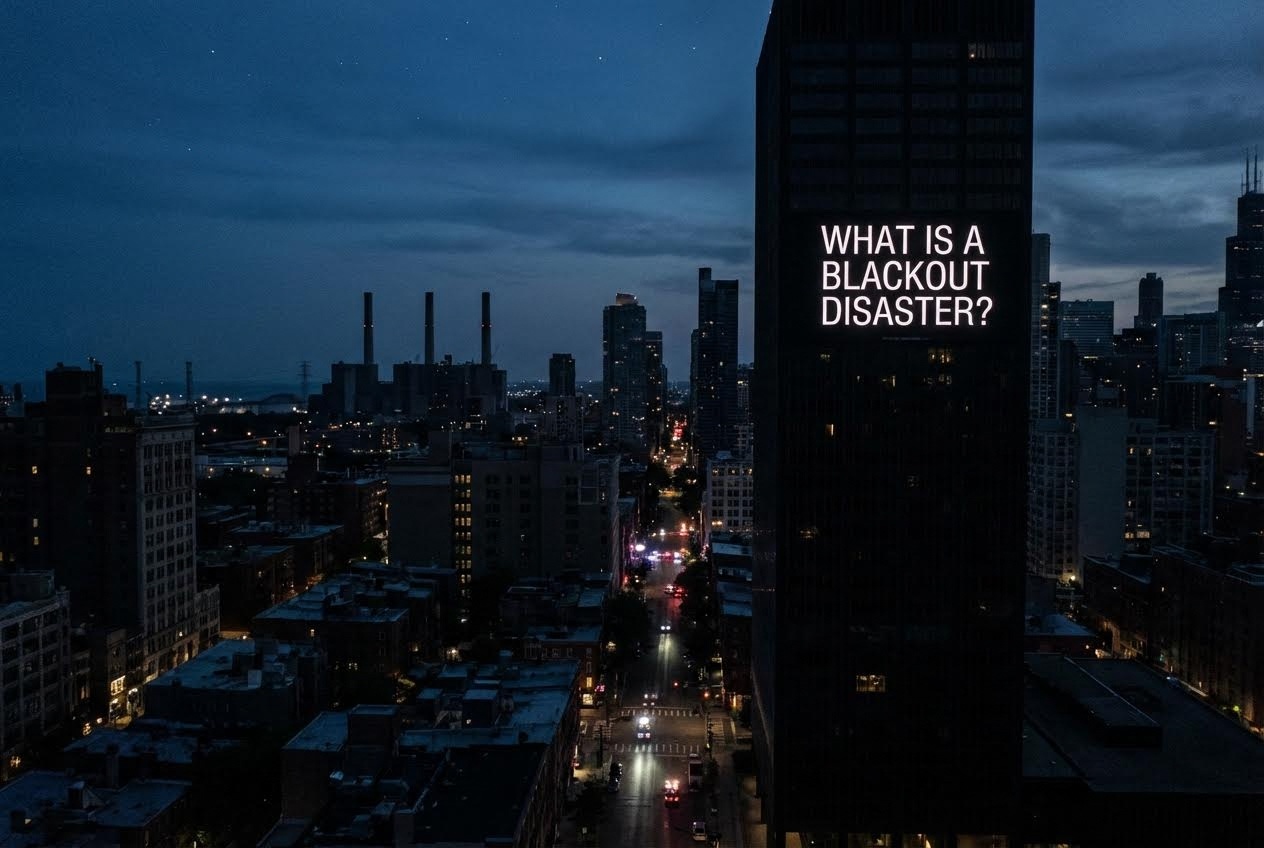
TLDR: A blackout disaster is a widespread, prolonged power outage affecting large populations for extended periods, typically caused by severe weather, grid failures, or cascading system collapses that disrupt the electrical power supply for days or weeks. Unlike brief power outages, blackout disasters create life-threatening conditions through loss of heating, cooling, refrigeration, medical equipment, and essential services across entire regions. These events require emergency preparedness, generator safety knowledge, and understanding of power outage safety protocols to protect families from carbon monoxide poisoning, food loss, and other dangers.
Blackout disasters represent the most severe form of power failure. They’re not the brief flickers that restore in minutes or the planned maintenance outages that utility companies schedule in advance. These catastrophic events plunge millions into darkness, shut down critical infrastructure, and create cascading emergencies across entire regions. Understanding what transforms an ordinary power outage into a full-scale disaster can save lives. This guide explains the mechanisms behind blackout disasters, the causes of power system failures, and essential safety tips for surviving when the electrical grid collapses. Whether you’re preparing for potential emergencies or trying to understand recent blackout events, this comprehensive overview provides the knowledge you need to recognize, prepare for, and survive blackout disasters.
What Defines a Blackout Disaster vs. Regular Power Outages?
Scale and duration separate blackout disasters from routine power interruptions. A typical power outage affects a neighborhood or small area and resolves within hours. A blackout disaster impacts vast regions—entire cities, states, or even multiple countries—for days or weeks. The 2003 Northeast Blackout affected 55 million people across eight U.S. states and parts of Canada. That’s a disaster-scale event.
Blackout disasters create cascading failures across critical systems. Hospitals switch to backup power. Water treatment plants struggle. Communication networks collapse. Transportation systems halt. The complete loss of electrical power for extended periods threatens public safety in ways brief outages don’t. People die from heat exposure, carbon monoxide poisoning from improper generator use, and lack of medical care when power-dependent equipment fails.
The economic impact distinguishes disasters from inconveniences. Ordinary power outages cost thousands in lost productivity and spoiled food. Blackout disasters cost billions. Businesses shut down completely. Food supplies spoil across entire distribution networks. The interruption ripples through every sector of the economy. Recovery takes weeks or months rather than hours. When the supply of electricity to millions vanishes simultaneously for extended periods, you’re experiencing a blackout disaster, not just a regular outage.
What Are the Main Causes of Power Outages That Become Blackout Disasters?
Severe weather triggers most blackout disasters. Hurricanes, ice storms, tornadoes, and extreme heat waves damage power lines, transmission lines, and electrical equipment on massive scales. Winter storms coat power infrastructure in heavy ice, snapping lines and toppling poles. Hurricane-force winds destroy power stations and substations. Heat waves drive excessive demand that overwhelms the power grid while simultaneously reducing generation capacity as rivers warm and thermal plants shut down.
Equipment failure at critical points can cascade into disaster. A single transformer explosion or power plant shutdown shouldn’t cause widespread blackouts—but when multiple failures occur simultaneously or when safety systems malfunction, small problems explode. The 2003 blackout began with overgrown trees contacting a single power line. Poor communication and failed backup systems allowed that localized issue to cascade across the entire electrical grid. One short circuit triggered the largest blackout in North American history.
Cyberattacks and physical sabotage represent emerging threats. Solar storms and electromagnetic pulses could theoretically disable vast sections of the electrical power supply without warning. Grid overload from air conditioning during heat waves creates rolling blackout situations that can spiral into disaster if generation can’t meet demand. Human error, aging infrastructure, and insufficient maintenance compound these risks. The cause of the blackout often involves multiple factors combining in unfortunate ways that overwhelm the power systems’ ability to recover.
How Do Brownouts Differ from Blackouts in Disaster Scenarios?
A brownout involves a drop in voltage in an electrical power system rather than complete power loss. The term brownout comes from the dimming of lights when voltage sags below normal levels. Your lights dim, motors run slower, and electronics may malfunction—but you don’t lose power completely. Brownouts typically last minutes to hours and are often intentional measures to prevent full blackouts.
Brownouts can cause significant equipment damage. Air conditioners, refrigerators, and other motor-driven appliances draw excessive current trying to operate at reduced voltage. This overheating can destroy compressors and motors. Modern electronics with sensitive components may suffer permanent damage from extended low-voltage conditions. While less dramatic than blackouts, brownouts still threaten appliances and can lead to complete blackout if the underlying grid stress isn’t resolved.
During disaster scenarios, utility companies may implement controlled brownouts to manage limited power available and prevent total grid collapse. These voltage reductions buy time for power suppliers to bring additional generation online or reduce load. However, if the situation worsens, brownouts escalate to rolling blackouts where different areas lose power completely in rotation. When even rolling blackouts can’t stabilize the grid, the entire system may crash into a disaster-scale blackout affecting everyone simultaneously. Understanding this progression helps you recognize when a manageable situation is deteriorating into disaster.
What Makes a Blackout a “Disaster” Rather Than an Inconvenience?
Temperature extremes transform blackouts into disasters. During winter, people without power lose heating and face hypothermia risks. Elderly populations and young children are particularly vulnerable. Summer blackouts during heat waves create life-threatening conditions as buildings become ovens. Heat-related deaths surge during extended power loss in hot climates. When the electrical power goes out during extreme weather, the situation escalates from inconvenience to deadly emergency within hours.
Medical dependency on electricity creates disaster conditions immediately. People who rely on electricity for medical devices—ventilators, oxygen concentrators, dialysis machines, refrigerated medicines—face life-threatening situations when power fails. Hospitals switch to generators, but home-bound patients may lack backup power sources. Pharmacies can’t dispense medications without power. The loss of power to medical equipment and facilities turns blackouts into medical emergencies affecting vulnerable populations first.
Duration determines disaster status as much as scale. A blackout affecting millions that restores in four hours causes disruption but not disaster. That same blackout lasting four days becomes catastrophic. Food loss occurs as refrigeration fails. Water systems stop pumping. Sewage treatment halts. Communication breaks down as cell tower batteries die. After 48-72 hours without power in a given area, the situation deteriorates from inconvenience to humanitarian crisis. When power is restored becomes the critical question that separates disaster from mere disruption.
How Do Power Systems and the Grid Fail During Blackout Disasters?
The electrical grid operates on razor-thin margins between generation and demand. Power systems must match supply and consumption precisely every second. When this balance breaks—through sudden loss of generation, transmission line damage, or demand spikes—frequency and voltage fluctuate dangerously. Protective systems disconnect sections of the grid automatically to prevent equipment damage. This is where cascading failures begin.
Each disconnection forces more load onto remaining sections of the power grid. These overloaded sections then disconnect to protect themselves. The cascade accelerates. What started as a localized problem spreads across interconnected regions within minutes. Circuit breakers trip. Power stations shut down automatically. The entire electrical grid can collapse before human operators even understand what’s happening. Modern power systems have improved protections, but the interconnected nature that normally provides resilience becomes a vulnerability during cascading failures.
Restoring power after grid-wide collapse requires a complex “black start” procedure. Power plants need electricity to start up—but there’s no electricity available. Special facilities with independent startup capability must begin the process. They energize transmission lines gradually, bringing other plants online step by step. This process takes hours or days depending on damage extent. If physical infrastructure sustained damage from the event that caused the blackout—destroyed power lines, damaged transformers, flooded substations—restoration takes even longer as repairs proceed alongside reactivation.
What Safety Tips Should You Follow During a Blackout Disaster?
Food and water become critical priorities within hours. Keep your refrigerator and freezer doors closed to preserve cold temperatures as long as possible. A full freezer stays frozen 48 hours; refrigerators keep food cold about four hours. Store emergency water—one gallon per person per day for at least three days. Don’t drink water if your municipal system warns of contamination. Without power to run treatment plants, water safety can’t be guaranteed. Keep food cold using ice from freezers or purchased from stores while available.
Eliminate fire and carbon monoxide risks that kill people during blackouts. Never use a gas stove, charcoal grill, or portable generator indoors or in attached garages. These produce lethal carbon monoxide concentrations in enclosed spaces. Use battery-powered flashlights instead of candles when possible. If using candles, never leave them unattended. Don’t use surge protectors during outages—unplug sensitive electronics to protect against damage from power surges when electricity returns. Turn off or disconnect major appliances to prevent overload when power is restored.
Stay safe by limiting travel and staying informed. Roads without traffic signals become dangerous. Gas stations can’t pump fuel without power. Emergency services may be overwhelmed. Stay home unless absolutely necessary. Use battery-powered radios for emergency information. Conserve phone batteries—cellular service may be limited as tower backups fail. Check on elderly neighbors who may need assistance. If you lose heating or cooling during temperature extremes, know when power will return or relocate to emergency shelters. Power outage safety means recognizing when staying home becomes more dangerous than evacuating.
How Can Generator Safety Prevent Carbon Monoxide Poisoning During Disasters?
Generators provide backup power but kill dozens of people annually through carbon monoxide poisoning. This invisible, odorless gas accumulates rapidly when generators run in enclosed spaces. Garages, basements, and areas near homes become death traps when generators operate too close. Even with doors and windows open, lethal concentrations build faster than air circulation can disperse them.
Generator safety requires strict distance and ventilation rules. Place generators at least 20 feet away from your home, pointing exhaust away from windows, doors, and vents. Never run them in attached garages, even briefly. Don’t position them where exhaust can enter your home through any opening. Install battery-operated carbon monoxide detectors throughout your home, especially near sleeping areas. These devices provide your only warning before poisoning causes unconsciousness and death. To prevent carbon monoxide tragedy, absolute compliance with outdoor-only operation is mandatory.
Home generators require professional installation with transfer switches to prevent backfeeding electricity into power lines. This protects utility workers trying to restore power and prevents equipment damage. Only connect appliances to portable generators using heavy-duty, outdoor-rated extension cords. Never plug generators directly into wall outlets. Keep generators dry and maintain them according to manufacturer specifications. During extended power outages, generator safety knowledge becomes life-or-death critical. Proper setup and operation protect your family while providing needed electricity during blackout disasters.
What Equipment and Supplies Help You Stay Safe During Extended Power Loss?
Battery backup systems for essential medical equipment must be ready before disasters strike. Anyone who relies on electrically powered medical devices needs redundant backup power sources. Uninterruptible power supplies (UPS) provide temporary power for computers and some medical devices. Larger battery backup systems can run critical equipment for hours. Home generators with proper installation offer longer-term solutions. Coordinate with healthcare providers and utility companies to ensure adequate backup plans for life-sustaining equipment.
Emergency supply kits should include multiple light sources. Battery-powered flashlights, LED lanterns, and headlamps eliminate dangerous candle use. Stock extra batteries or invest in rechargeable batteries with solar chargers. A portable charger or power bank keeps phones operational when outlets are dead. Battery-powered or hand-crank emergency radios provide news and weather updates when other communication fails. First aid supplies, prescription medications, and over-the-counter remedies address medical needs when pharmacies close.
Temperature management supplies protect against extreme weather. Warm clothing, blankets, and sleeping bags preserve body heat during winter blackouts. Battery-powered fans and spray bottles help manage heat, though options are limited without air conditioning. Non-perishable food that doesn’t require cooking—canned goods, protein bars, peanut butter—sustains you when stoves won’t work. Manual can openers, disposable plates, and eating utensils round out supplies. These preparations reduce the impact of blackout disasters on your household and increase survival odds during extended emergencies.
How Do Rolling Blackouts Differ from Disaster Blackouts?
Rolling blackouts represent controlled, intentional power interruptions implemented to prevent grid collapse. When electricity demand exceeds generation capacity, utility companies rotate outages across different areas. Each section loses power for 30 minutes to several hours, then another area shuts down while the first restores. This manages limited power in a given area without crashing the entire grid. California implemented rolling blackouts during the energy crisis and heat waves when demand threatened system stability.
A rolling blackout allows some power to remain available continuously—just not everywhere simultaneously. Critical facilities like hospitals may receive exemption from rotation schedules. Citizens know when power will go and when it returns. Compare this to disaster blackouts where the entire grid fails simultaneously without warning or predictable restoration timeline. Rolling blackouts are preventive measures; disaster blackouts are system failures.
However, rolling blackouts can escalate into disasters if underlying problems worsen. If generation capacity drops further or demand continues climbing, rolling schedules become inadequate. The grid may crash completely, transforming controlled rotation into uncontrolled collapse. Additionally, repeated rolling blackouts stress equipment and frustrate populations, though they remain preferable to total system failure. Understanding this distinction helps you recognize whether you’re experiencing managed load reduction or actual grid disaster requiring different preparation and response strategies.
What Should You Know About Recovery After a Blackout Disaster?
Power restoration proceeds in stages, not all at once. Critical infrastructure—hospitals, emergency services, water treatment—receives priority. Residential areas follow, often in sequence from main distribution lines outward. Don’t assume your area will restore immediately when nearby areas regain power. The power company must verify line integrity, balance loads, and prevent overwhelming the recovering grid. Patience during this process, while frustrating, prevents triggering another collapse.
When your power comes back, wait before reconnecting everything. Voltage may fluctuate as the grid stabilizes. Reconnect appliances gradually over 10-15 minutes to avoid overload. Check refrigerated foods with a thermometer—discard anything exposed to temperatures above 40°F for more than two hours. Inspect refrigerated medicines and contact healthcare providers about replacement if temperature-sensitive medications warmed excessively. Document food loss and property damage for insurance claims.
Watch for signs of damage from the blackout or the event that caused it. Check for unusual odors suggesting gas leaks or electrical problems. Test water before drinking if authorities issued warnings. Inspect food supplies for spoilage. Be alert for electrical shock hazards from damaged wiring or equipment. Report ongoing outages or hazards to your utility immediately. Know when power is fully stabilized before resuming normal activities. Recovery after blackout disasters takes days to weeks—rushing the process creates new dangers that compound the original emergency.
Essential Blackout Disaster Preparedness Knowledge
- Blackout disasters affect millions for extended periods, not brief local outages – Scale, duration, and cascading infrastructure failures distinguish disasters from routine power interruptions that restore within hours.
- Severe weather causes most disaster-scale blackouts – Hurricanes, ice storms, extreme heat, and winter storms damage power lines and transmission infrastructure while creating excessive demand that overwhelms power systems.
- Brownouts represent voltage drops rather than complete power loss – The term brownout comes from the dimming of lights during voltage sags; brownouts can damage equipment and may escalate to full blackouts if grid stress continues.
- Temperature extremes make blackouts life-threatening – Loss of heating during winter or air conditioning during heat waves creates medical emergencies within hours, especially for vulnerable populations and those dependent on medical equipment.
- Cascading failures spread rapidly across interconnected grids – When one section disconnects to protect itself, remaining areas overload and disconnect in sequence, collapsing entire electrical grids before operators can respond effectively.
- Generator safety requires outdoor operation at least 20 feet from buildings – Carbon monoxide from generators kills quickly in enclosed spaces; indoor operation, even in garages with doors open, produces lethal gas concentrations.
- Food safety depends on keeping refrigerator and freezer doors closed – Refrigerators keep food cold four hours, full freezers stay frozen 48 hours—but only if doors remain shut during power loss.
- Rolling blackouts differ from disaster blackouts in control and predictability – Utilities implement rolling blackouts intentionally to manage demand; disaster blackouts result from uncontrolled system failures without predictable restoration.
- Medical equipment dependency requires backup power planning before disasters – Anyone who relies on electricity for medical devices needs battery backup, generators, or evacuation plans developed with healthcare providers before emergencies strike.
- Black start procedures require hours or days for full grid restoration – Power plants need electricity to start; special facilities must begin the process, energizing transmission lines and bringing plants online gradually to rebuild the electrical grid.
- Emergency supplies should include multiple weeks of food and water – One gallon of water per person per day plus non-perishable food, flashlights, batteries, first aid supplies, and medications prevent dangerous shortages during extended power loss.
- Power surges when electricity returns can damage electronics – Unplug sensitive equipment during outages and reconnect gradually when power is restored to protect against voltage spikes as the grid stabilizes.
- Duration transforms inconvenience into humanitarian crisis – After 48-72 hours without power, food spoilage, water system failures, sewage problems, and communication breakdown create disaster conditions requiring emergency response.
- Carbon monoxide poisoning spikes during blackouts from improper heating – Never use gas stoves, charcoal grills, or camp stoves indoors; install battery-operated carbon monoxide detectors and know the signs of poisoning.
- Economic impacts of blackout disasters reach billions in losses – Business shutdowns, spoiled food supplies, damaged equipment, and recovery costs distinguish disaster-scale blackouts from routine power outages in financial terms.